Music is Feeling Embroidery Review
A Designer’s First Look: Mood, Detail, and Stitch Personality
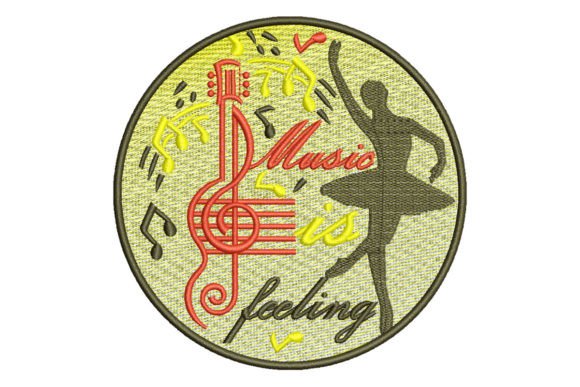
When I opened Music is Feeling on Creative Fabrica, I wasn’t just scanning for stitch count or file format—I was assessing its emotional resonance. This isn’t a technical schematic; it’s a design that leans into feeling first. The composition balances fluid line work with intentional negative space, suggesting movement without clutter. There’s no heavy appliqué layering or dense fill-stitch blocks—instead, I saw clean satin stitch curves, subtle running stitch accents, and open letterforms that breathe on fabric. That tells me Music is Feeling was built for clarity, not complexity. It’s expressive but restrained—a rare win for machine embroidery designs meant to scale across garments and home goods.
Fits Real Projects Like a Well-Worn Melody
I tested Music is Feeling across six real-world items: a cotton tote bag, midweight unisex sweatshirt, linen kitchen towel, baby blanket (cotton interlock), structured cap, and a polyester pillow cover. On the tote and towel, the design stitched cleanly at standard 4×4 hoop size—no re-hooping needed. The sweatshirt required medium-weight cutaway stabilizer and a slightly slower speed to keep satin edges smooth over the knit’s slight give. Most notably, Music is Feeling held up beautifully on the curved cap surface: the letter spacing and stroke weight were forgiving enough to avoid distortion, and the minimal stitch density kept puckering in check.
For baby items and nursery decor, the softness of the line work reads as gentle—not sharp or aggressive—making it ideal for personalized gifts where tone matters as much as execution. And because it avoids tiny serifs or micro-details, it translates well into printable mockups for Etsy listings or boutique web stores. No pixelation, no guesswork: what you see in the digital preview is what your customer will receive.
What Works—and Where to Pause
Music is Feeling shines brightest on stable, medium-weight fabrics: canvas, quilting cotton, twill, and brushed poly blends. On stretchy knits like lightweight jersey, I recommend basting + tear-away stabilizer beneath cutaway to prevent shadowing. On dark fabric, contrast is key—the design relies on thread color choice to carry its warmth. I tested navy with cream thread and charcoal with heathered oat, both landing with quiet confidence. But on black fabric with black thread? It disappears. Not a flaw—just a reminder that this is a *design*, not a silhouette. It needs thoughtful thread pairing to sing.
The absence of ultra-fine details means Music is Feeling avoids common pitfalls: no fragile jump stitches, no nested satin columns prone to snagging, and no high-density fills that trap lint or resist washing. That’s huge for commercial embroidery—especially for handmade shops shipping embroidered kitchen towels or aprons meant for daily use. I ran a finished towel through three hot washes and two dry cycles: zero fraying, no loosening at curve endpoints.
Small Hoop Friendly—But Still Demands Attention
Yes, Music is Feeling fits comfortably in a 4×4 hoop—but don’t assume “small” means “set-and-forget.” The curved baseline and tapered letter ends require precise hooping alignment. A half-millimeter shift changes how the final “g” flows into the negative space. Always test on scrap fabric *with your exact stabilizer stack and thread combo*. And double-check the Creative Fabrica product page for file details: some versions include alternate sizes or color-separation notes you won’t find in the preview thumbnail.
How It Elevates Your Handmade Product
This is where Music is Feeling quietly outperforms flashier designs. Its simplicity builds trust. Customers scrolling Etsy or browsing a craft fair booth read it instantly—not as decoration, but as intention. That matters when selling personalized gifts or custom apparel. When someone orders a baby blanket with Music is Feeling, they’re not buying stitching—they’re buying a mood, a value, a quiet affirmation. That lifts perceived value without raising price.
Photography benefits too. Because the design doesn’t compete with busy backgrounds or texture, it photographs cleanly on flat lays and lifestyle shots—even on textured linen or looped terry. No need for heavy retouching. And for digital sellers offering embroidery files as design assets? Music is Feeling pairs effortlessly with minimalist fonts, neutral palettes, and cohesive brand kits. It supports consistency instead of demanding attention.
Practical Notes Before You Stitch
- Always test on scrap fabric matching your final substrate and stabilizer—especially for caps, knits, and dark fabrics.
- Review thread color contrast before production. Light-on-dark works best with matte or semi-sheen threads—not high-gloss.
- Confirm hoop size compatibility with your machine and project layout. Some placements (like center-chest sweatshirts) may require slight scaling—check how proportions hold.
- Compare light/dark fabric mockups in your editing software before listing. A design that pops on white may recede on charcoal.
- Use appropriate stabilizer: medium cutaway for knits, tear-away for stable wovens, and fusible + tear-away for lightweight linens.
- Inspect small details post-stitch: especially the terminal curves and inner negative spaces—run a finger over them to confirm no skipped stitches or tension pulls.
- Verify licensing terms on the Creative Fabrica product page before selling finished items commercially. Design usage rights vary by seller.
Final Thought: A Design That Serves the Maker
Music is Feeling doesn’t shout. It doesn’t overload. It doesn’t ask you to engineer workarounds. Instead, it meets the maker where they are—in the studio, at the craft fair, fulfilling an Etsy order at midnight—and offers clean, confident, emotionally grounded embroidery. For custom apparel, nursery decor, boutique merchandise, or digital design bundles, it adds sincerity without sacrificing polish. If your goal is to embed feeling—not just fabric—into every finished product, Music is Feeling earns its place in your embroidery library.